Seiten

Showing posts with label UNESCO. Show all posts

14 Nov 2022

Porto, Portugal


Porto is the second largest city in Portugal, located in the northern part of the country on the estuary of the Douro River. It is part of two UNESCO World Heritage Sites. The city's historic centre, the impressive Luis I bridge which spans the river Douro as well as the Monastery of Serra do Pilar were inscribed into the World Heritage list in 1996. The "faded grandeur" is famous about the city, something that can only be found anymore in very few places, like Cuba or Argentina. 
Porto is namegiver to the whole country as well as the delicious Port wine, mainly produced in the Douro Valley, the second UNESCO World Heritage Site.

Thank you very much Isabel for this stunning sunset view!


16 Nov 2021

Chinese Palace, Oranienbaum - Personal Residence of Catherine II of Russia


This, in my eyes, exceptionally beautiful postcard shows the Chinese Palace within the compound of the Russian royal residence of Oranienbaum, west of Saint Petersburg, at the Gulf of Finland.

It was built in 1762 to 1768 in Italian style and originally there was just one floor. In 19th century new features were added as well as a second floor. It was known at first as "Dutch House" but due to lots of decorations and works of art from China is acquired its current name.

I just love the colours and the reflections in the lake.

Oranienbaum is part of the UNESCO World Heritage Site: Historical Centre of the town of Lomonosov Including the Palace and Park Ensemble of the Upper Park and Lower Garden.

Thank you very much for this true beauty, Julia Kazachinskaya !!!

10 Aug 2018

Jubilee Clock Tower, George Town, Penang, Malaysia (UNESCO)


The Jubilee Clock Tower in George Town, Penang, Malaysia was built by Cheah Chen Eok in 1897 to commemorate the diamond jubilee of Queen Victoria's reign. It is designed in Moorish style and due to bombings in the Second World War it is slightly tiltet. On the left of the postcard is the stylized, betel nut shaped Penang Fountain. Both sights are  located at the King Edward Palace near the Espanade.
The historical center of George Town was inscribed into the UNESCO World Heritage List in 2008.
Thank you very much for this postcard Minh Way Poh !!!

29 Jul 2018

Trulli of Alberobello, Italy (UNESCO)


Alberobello is located in Apulia, Italy and is famous for the wonderful Trulli buildings. Legend says that the Trulli were invented to circumvent the paying of taxes. They are all built with loosely fitting stones, found in the surroundings, without any mortar. According to legend, that way, the houses were easy to dismantle and did not count as permanent settlements in case the tax collectors were touring the area . The roofs often have symbols painted on the stones, mostly of Christian origin. Some of the houses are over 300 years old.
Standing on the opposite hill looking down to the part of town with the Trulli, it looks like a sea of gray jelly bag caps, totally enchanted !!
In 1996 the Trulli of Alberobello were inscribed into the UNESCO World Heritage List.
I sent this card home from our visit in this beautiful place.

6 Jul 2018

Park Güell, Barcelona, Spain (UNESCO)


It all started in 1900 when Count Eusebio Güell bought a tree-covered hillside just outside of the boundaries of Barcelona. He intended this space to become a sanctuary for the wealthy and assigned the design to Antoni Gaudí, a renowned Catalan architect at that time. Construction lasted 14 years. The whole project turned out to be a commercial flop. In 1922 the city bought the estate and intended it to become a public park. Its gates opened 4 years later in 1926 and this enchanted place has since become one of the most popular sites in the city.
The Park Güell and 7 buildings, all designed by Antoni Gaudí were inscribed into the UNESCO World Heritage List in 1984 with an extension added in 2005, as Works of Antoni Gaudí.

Thank you so much for this postcard, Belén !!!

4 Jul 2018

Ellora Caves, Kailasa Temple, India (UNESCO)


Kailasa Temple is one of 34 cave temples and monasteries known as the Ellora Caves, India. All of them were dug side by side in the wall of a basalt cliff of the Sahjadari hills near Aurangabad, India. The Kailasa Temple, built in 8th century is famous for its vertical excavation. Carvers started at the top of the rock and worked their way downward. 200.000 tons of rock had to be removed and this unbelievable tast was achieved in less than 2 decades. Everything in and around the temple, the pillars even the sculptures was carved from the same rock. Originally it was coated in a thick layer of white plaster so that it looked like covered in snow, thus resembling the sacred mountain Kailash in Nepal, said to be the home of Shiva. The temple was dedicated to this deity.
Ellora Caces were inscribed into the UNESCO World Heritage List in 1983.
Thank you Piyush Bafna for this wonderful postcard !!!

1 Jul 2018

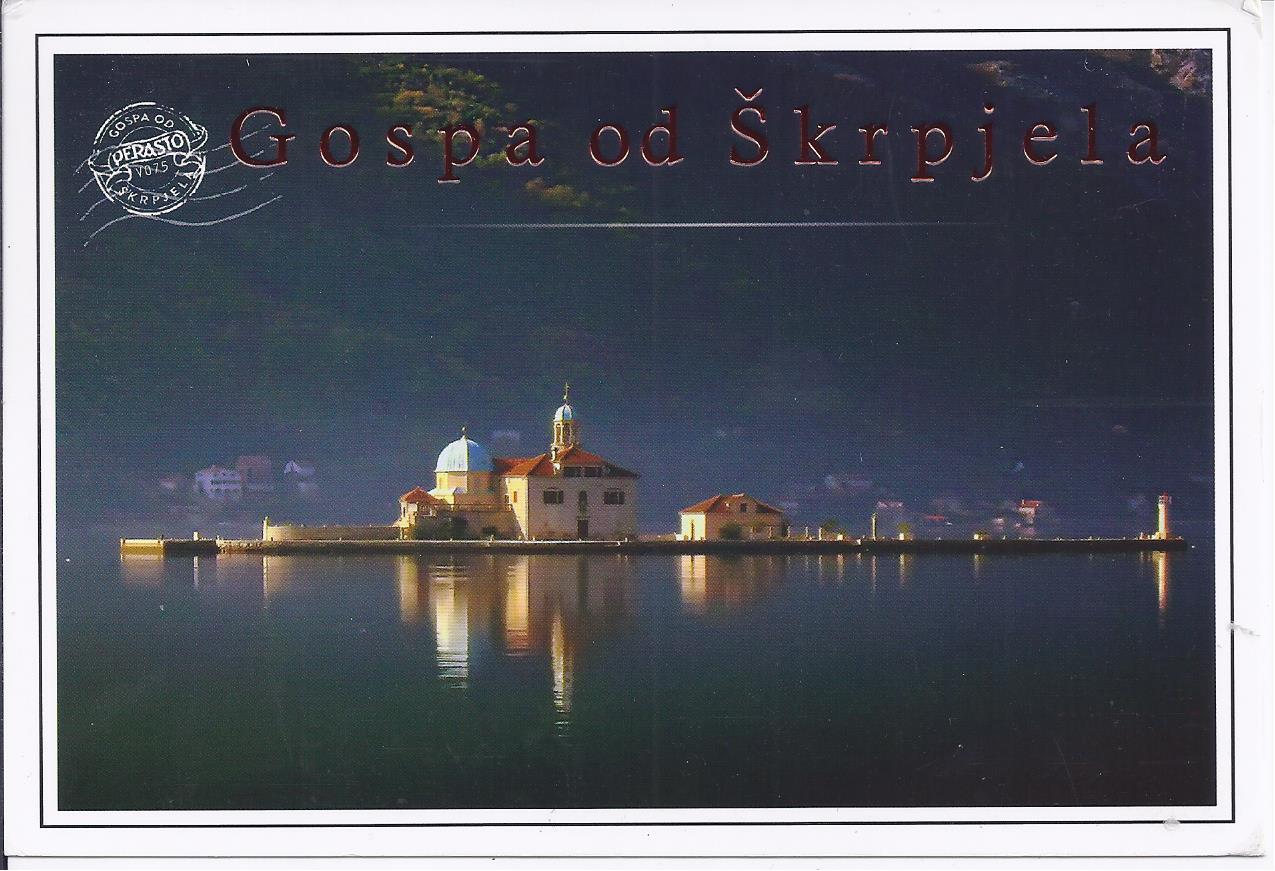
Gospa od Skrpjela (Our Lady of the Rocks) Bay of Kotor, Montenegro (UNESCO)


The church of Our Lady of the Rocks is located on a small, artificial islet off the Perast coast, in the Bay of Kotor.
According to legend, 2 fishermen found a picture of the Madonna with Child on the rock in the bay on July 22, 1452. One of them was crippled. At the risk of his life he grabbed the icon and carried it home. The next morning, he miraculously could walk again. He ran to the room where he had put the icon to give his thanks, but it was gone.  So he had no proof to show the priests, that the icon had healed him. Months later he found that same icon on the very same spot again, waiting for him on the rock in the bay. This time he took it and ran straight to the priests in Perast to show them. With such a micracle happening in their small town, it was decided that a shrine had to be built on the rock. But how to do that on just a small slab of stone? So the fishermen took all their discarded old a boats charged them with big stones from the surrounding land and sank them all around the rock.   Thus, the islet grew and rose out of the water so that the shrine could be built.  The sanctuary was dedicated to the Madonna with Child who was honoured henceforth as portector of the fishermen and sailors. An oath was sworn, that every seaman would add a stone to this islet whenever they returned from a successful voyage.
The original chapel was plundered by pirates and in 1630 replaced by Venetian settlers.
The islet and church is part of the UNESCO World Heritage Site Natural and Culturo-Historical Region of Kotor.
I sent the card home for my collection from our cruise to the Eastern Mediterranean.

20 Jun 2018

Oreshek Fortress (Shlisselburg), Russia


Oreshek Fortress or Shlisselburg is located on an island in Ladoga Lake, not far from St. Petersburg. It was built by Grand Prince Yuri of Moscow on behalf of the Novgorod Republic in 1323 and has served as a Russian forpost in this area for century. The original structure was made from wood and finally changed to stone in 1352. Over the centuries the fortress was often attacked and besieged, demolished, rebuilt and  fortified. For a while it was under Swedish rule and in World War II a contingent of 350 Russian soldiers held the fort against the advancing German troops for 500 days, cutting the last transit route from Leningrad to the mainland. Thus the food and provisions never reached the front and remained under Russian control. The German troops heavily damaged the fortress but were never able to conquer it. Only 6 of the original 10 towers survived the siege, which was finally lifted in January 1943.
Both the island with fortress as well as the town of Shlisselburg are part of the UNESCO site Historic Centre of Saint Petersburg and Related Group of Monuments (1990)
Thank you Natalia for this wonderful postcard !!

11 Jun 2018

Ravello, Amalfi Coast, Italy (UNESCO)


Ravello is a small town an a rock 350 meters above the Amalfi Coast in Campania, Italy. It was the perfect place for a shelter from barbarian invasions in 5th century. 400 years later it became once again a refuge, this time for several rebelious noble families fleeing the authority of the Doge. In the 11th century Ravello's importance rose due to the production of "Celendra Wool" but then declined again under the Norman rule. This change in fates, however drastic, could never destroy the town's breathtaking beauty and charm. Quite a number of celebrities fell in love with Ravello, like Greta Garbo, Winston Churchill, Richard Wagner and a lot more.
Today it is a major tourist attraction also because of the spectacular view down to the Amalfi coast. In 1997 it was inscribed into the UNESCO World Heritage List as part of the site Costiera Amalfitana.
Thank you so much Giulio Fragonara for this wonderful postcard !!!

1 Jun 2018

Palau de la Música Catalana (Palace of Catalan Music), Barcelona, Spain (UNESCO)


What a fantastic evening view of the the Palau de la Música Catalana in Barcelona. This really exceptionel concert hall was designed by Lluis Dommènech i Montaner in Catalan Art Nouveau style and opened in 1908. The facade is made from brick and is richly decorated with mosaics, sculptures and stained glass. The inside is just as wonderful.
There are concerts throughout the year from classical, syphonic and chamber music to jazz and traditional Catalan music.
In 1997 the Palau de la Música Catalana was inscribed into the UNESCO World Heritage List together with the Hospital de Sant Pau.
Thank you Tatiana for this fantastic postcard !!

27 May 2018

Albi, Episcopal City, France (UNESCO)


The Episcopal City of Albi is located in the south of France. In 2010 the city around the cathedral Sainte-Cécile was inscribed into the UNESCO World Heritage list.
The cathedral is a masterpiece of the Southern Gothic style and considered as the largest brick cathedral in the world. The Palais de la Berbie, now accomodating the Toulouse-Lautrec Museum,  was completed in the late 13th century, which makes it even older than the Palais des Papes in Avignon. The Old Bridge, as seen on the card, is still the one that was originally built in 1035 when Albi expanded to the oposite side of the river Tarn. It spans 151 meters and rests on 8 impressive arches. Later it was clad in brick and reinforced.
The city's most famous son is Henri de Toulouse-Lautrec. The French painter and illustrator was born in Albi in 1864.
Thank you Axel van Looy for this fantastic postcard !!!!

26 May 2018

Potala Palace, Lhasa, Tibet, China (UNESCO)


This postcard shows Potala Palace, in Lhasa. Until the Tibetan Uprising in 1959, Potala Palace was the residence of the Dalai Lama. During the uprising the 14th Dalai Lama fled to India. Potala Palace has been turned into a museum and in 1994 it was inscribed into the UNESCO World Heritage List.
Construction began in 1645 under the 5th Dalai Lama on a 3,700 meter high mountain in the centre of Lhasa Valley
Thank you Twinkle for this spectacular card !

Geirangerfjord, Norway (UNESCO)


This is one of the places that are still on my "Must See" list. Geirangerfjord in Norway is one of the countries most visited tourist sites. The 15 km long fjord is surrounded by some of the steepest mountains of the entire west coast, which leaves very little room for settlements. At the end of the fjord there is the small town Geiranger.
In 2005 Geirangerfjord was inscribed into the UNESCO World Heritage List together with Naroyfjord.
Thank you Jörg for this wonderful postcard !!!

25 May 2018

Palace of Westminster (Houses of Parliament), London, U.K. (UNESCO)


I already have several cards showing the Palace ofWestminster, butfor me this is easily one of the most beautiful.
It is located in the city of Westminster in central London. The first royal palace in this place was built in 11th century and was the residence of the kings of England until 1512 when a fire destroyed much of the complex. It was rebuilt, and became home of the Parliament until another fire almost completely destroyed the palace in 1834. The only parts of the original building are Westminster Hall, the Jewel Tower, the cloisters of St. Stephen and the Chapel of St. Mary Undercroft.
The palace is in possession of the crown and for ceremonial purposes still functions as a royal residence.
Together with Westminster Abbey and St. Margret's Church, the Palace of Westminster was inscribed into the UNESCO World Heritage List (1997)
Thank you Claire for this beautiful view !!!

24 May 2018

Penguins on Snares Islands, Subantarctic Aotearoa / New Zealand (UNESCO)


Another treasure sent by my postcard hero Rod Eime :)
The subantarctic islands of New Zealand, or Aotearoa in Maori language, have been a UNESCO World Heritage Site since 1998. The Snares Islands (Tini Heke in Maori language) are located southwest of Stewart Island. The Snares crested penguin is endenic to the island along with 3 other land birds. The islands have the distinction of being the only forested group of Subantarctic islands with no introduced mammals.
Thank you a lot Rod Eime for this awesome card !!!

Kolyvanskoye Lake, Golden Mountains of Altay, Russian Federation (UNESCO)


Beautiful Kolyvanskoye lake in the Golden Mountains of Altay, a massive mountain range in Siberia. The name Altay comes from the Mongolian word "Altan" which translates as Golden. They are among nature's most marvellous gems, rich in diversity and beauty. The Altay covers an area of 845.000 square kilometers.
Thank you Vera for this beautiful card!!

8 May 2018

Venice and Grand Canal, Italy (UNESCO)


The Grand Canal is one of the most important water-traffic corridors of Venice. It is 3.8 kilometers long, up to 90 meters wide and the average depth is 5 meters. The banks are lined with more than 170 buildings, palazzos dating back to 13th up to 18th century. They rise out of the water without pavement, so the only way to reach them is by boat.
A major attraction for tourists are gondola rides along the canals of Venice.
Thank you Edoardo Galletti for this amazing evening view !!

6 May 2018

Chiesa di San Giovanni degli Eremiti (St John of the Hermits), Palermo, Sicily, Italy (UNESCO)


St. John of the Hermits is located in Palermo, the capital city of the beautiful island of Sicily, which is part of Italy. I won this card in a Facebook lottery, and when checking on the church I was surprised to find out it was a missing UNESCO Site in my collection. Big smile !
The origins of the church go back to the 6th century. It was later converted into a mosque, then again back into a church. In 1136 it was entrusted to the Benedictine monks of Saint William of Vercelli.
It was remodified a few times, but somehow the architects always kept to the quite distinct Arab style. It was named the Arab-Norman Culture. Around 1880 the church was restored again, this time attempting to return it to the medieval look. The red domes, though, still make it very clear that there was a strong Arab influence.
St. John of the Hermits is part of the UNESCO Site Arab-Norman Palermo and Cathedral Churches of Cefalù and Monreale.
Thank you very much Beate Di Guardia for this beautiful card !!!

5 May 2018

Amsterdam and its Canals, Netherlands (UNESCO)


Obviously I kind of developped a taste for evening views as of late :) This postcard is no exception.
Amsterdam is an absolutely amazing city! It started out in the 12th century as a tiny fishind village and over the centuries developped  into the leading centre for finance and diamonds and one of the most important ports in Europe during the Dutch golden age in 17th century. It is the capital of the Netherlands, the government seat though is in The Hague.
The city has more than 100 kilometers of canals (grachten), 90 islands and 1.500 bridges, which gave Amsterdam the nickname "Venice of the North". The 17th century canal ring with Prinsengracht, Keisersgracht, Herengracht and Jordaan are listed among the UNESCO World Heritage Sites.
Thank you Mirjam for sending this beautiful card for the Postcrossing Favourites Tag !!!!

1 May 2018

Basilica Santa Maria della Salute, Venice, Italy (UNESCO)


The beautiful Basilica of Santa Maria della Salute, designed by Baldassare Longhena in Baroque style,  is located on the narrow finger of Punta della Dogana between the Canale Grande and Giudecca Canal, just opposite of the Piazza San Marco, Venice. It was built in 1631 to commemorate the end of an unusually bad outbreak of the plague a year before which killed a huge number of people.
Thank you Edoarde Galletti for this awesome view of the Basilica !!!